AutoSurrogate: An LLM-driven multi-agent framework for autonomous construction of deep learning surrogate models in subsurface flow
A language-model agent that builds a deep learning surrogate for subsurface flow simulation from a plain-language request.
Read the paperPreprint on arXiv
The problem
Simulating flow underground at high fidelity is slow, and work such as uncertainty quantification needs many runs. A deep learning surrogate is far faster, but building one takes machine learning expertise that most domain scientists do not have.
What we found
We tested AutoSurrogate on a 3D geological carbon storage case and a 2D underground hydrogen storage case. With no manual tuning, it outperformed a range of baseline models and domain-agnostic AutoML methods.
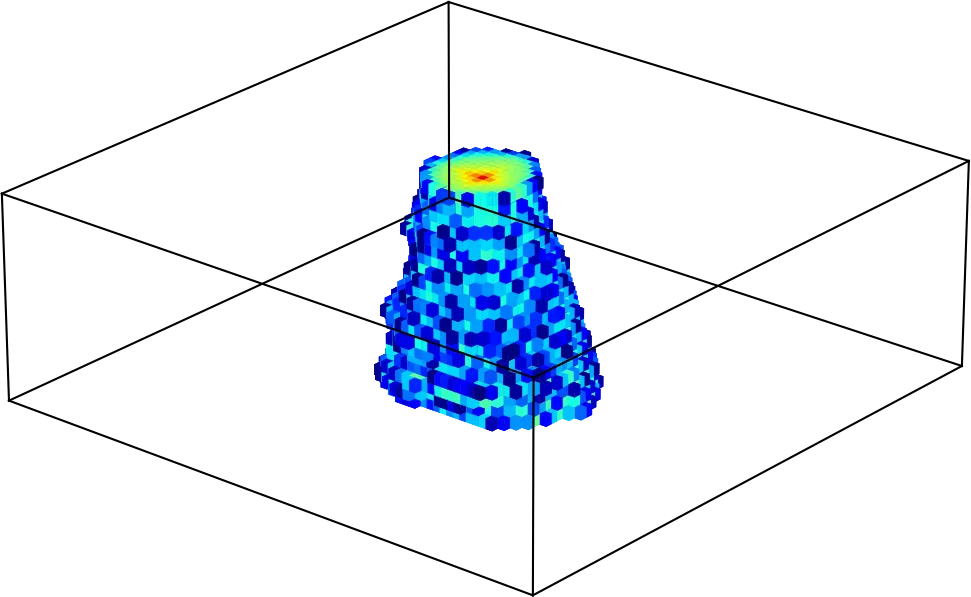
Simulation
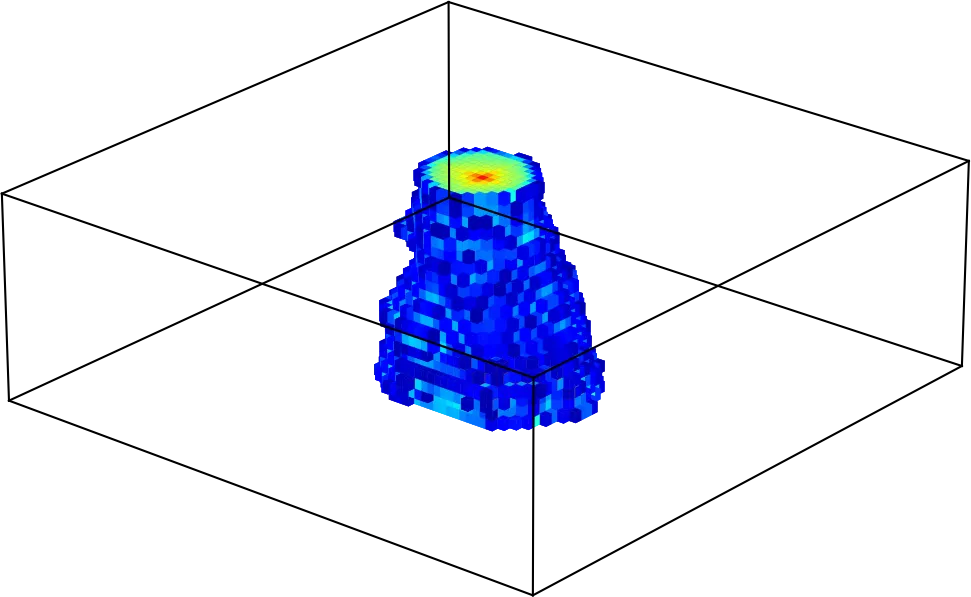
AutoSurrogate
The plume of CO₂ in the storage aquifer at year 30, for one test case: what the simulator computes, and what the surrogate that AutoSurrogate built predicts.
Abstract
High-fidelity numerical simulation of subsurface flow is computationally intensive, especially for many-query tasks such as uncertainty quantification and data assimilation. Deep learning (DL) surrogates can significantly accelerate forward simulations, yet constructing them requires substantial machine learning (ML) expertise, from architecture design to hyperparameter tuning, that most domain scientists do not possess. Furthermore, the process is predominantly manual and relies heavily on heuristic choices. This gap remains a key barrier to the broader adoption of DL surrogate techniques.
In this work, we present AutoSurrogate, a large-language-model-driven multi-agent framework that empowers practitioners without ML expertise to build high-quality surrogates for subsurface flow problems through natural-language instructions. Given simulation data and optional preferences, four specialized agents collaboratively execute data profiling, architecture selection from a model zoo, Bayesian hyperparameter optimization (HPO), model training, and quality assessment against user-specified thresholds. The system also handles common failure modes autonomously, including restarting training with adjusted configurations when numerical instabilities occur and switching to alternative architectures when predictive accuracy falls short of targets. In our setting, a single natural-language sentence can be sufficient to produce a deployment-ready surrogate model, with minimal human intervention required at any intermediate stage.
We demonstrate the utility of AutoSurrogate on two representative subsurface flow problems, including a 3D geological carbon storage case and a 2D underground hydrogen storage case, where surrogate models are constructed to map geological properties (e.g., permeability, porosity) to spatio-temporal pressure and saturation fields. Without any manual tuning, AutoSurrogate is able to outperform a range of baseline models and domain-agnostic AutoML methods. The results demonstrate strong potential of the AutoSurrogate framework for practical deployment in scientific and engineering applications.